How to Pass HESI A2 Anatomy and Physiology With AI Study Tools
You have three weeks until your HESI A2. You have 400 pages of anatomy and physiology notes, a textbook that weighs more than your backpack, and a growing sense of dread every time you open your laptop.
The Anatomy and Physiology section of the HESI A2 is notorious for a reason. It covers everything from cellular biology to the skeletal system, from the cardiovascular pathways to the endocrine glands. Your nursing school admission depends on this score, and yet the sheer volume of material makes it feel impossible to study effectively.
Here is the brutal truth that nobody preparing for the HESI A2 wants to hear: most students spend more time organizing their study materials than actually learning from them. They rewrite notes. They highlight textbooks. They spend entire weekends making flashcards by hand, typing definitions into apps, formatting question-and-answer pairs until their eyes blur.
And then they run out of time before they have actually tested themselves on any of it.
What if there was a way to skip the preparation phase entirely and jump straight into active learning? What if you could take your existing notes, your messy handwritten diagrams, your professor’s lecture slides, and transform them into organized study materials, flashcards, and practice quizzes in under a minute?
That is exactly what AI study tools like Cruxly make possible. And for nursing students facing the HESI A2, this technology is not just convenient. It might be the difference between admission and rejection.
Why the HESI A2 Anatomy and Physiology Section Breaks So Many Students
Before we talk about how to study, we need to understand why this particular section causes so much trouble.
The HESI A2 Admission Assessment is a standardized exam used by nursing schools across the United States to evaluate prospective students. While it covers multiple subjects including math, reading comprehension, vocabulary, and grammar, the Anatomy and Physiology section is consistently rated as the most challenging by test-takers.
The reasons are not hard to identify. First, the scope is enormous. The A&P section can include questions on any of the following systems: skeletal, muscular, nervous, endocrine, cardiovascular, lymphatic, respiratory, digestive, urinary, and reproductive. Within each system, you need to know structures, functions, locations, and relationships. That is hundreds of individual facts, and any of them could appear on your exam.
Second, much of the content is visual and spatial. Understanding how blood flows through the heart chambers, or how a nerve impulse travels down an axon, requires more than just memorizing definitions. You need to visualize processes, understand sequences, and recognize relationships between structures.
Third, the HESI A2 uses application-based questions, not just recall. You might know that the femur is the longest bone in the body, but can you identify which muscle group is primarily responsible for extending the knee? The exam tests whether you can connect isolated facts into functional understanding.
Finally, most students taking the HESI A2 are learning this material for the first time or reviewing it after a gap. Unlike nursing students who have been immersed in clinical content for years, HESI A2 candidates are often balancing prerequisite courses, jobs, and family responsibilities while trying to master an entire textbook worth of content.
The result is predictable. Students feel overwhelmed, default to passive study methods like re-reading and highlighting, and arrive at the exam without having truly tested their knowledge. Their scores reflect this lack of active preparation.
The Problem With Traditional HESI A2 Study Methods
Let us walk through how most students prepare for the HESI A2 Anatomy and Physiology section, and why these methods consistently fall short.
The typical approach looks something like this: Buy a HESI A2 study guide or prep book. Read through the anatomy and physiology chapters. Highlight important terms. Maybe copy some definitions into a notebook. Perhaps spend a few hours making flashcards on Quizlet or writing them out by hand. Take a practice test the week before the exam. Panic when you realize how much you have forgotten.
This approach fails for several interconnected reasons.
Passive review creates an illusion of competence. When you read your notes or a textbook chapter, the material feels familiar. You recognize the terms. You can follow the explanations. This familiarity tricks your brain into thinking you have learned the content, when in reality you have only been exposed to it. Recognition and recall are not the same thing. Recognizing that “the mitochondria is the powerhouse of the cell” when you read it is very different from being able to explain cellular respiration when someone asks you about it.
Manual flashcard creation consumes time you should spend learning. Consider the math. If you need to create flashcards for 15 body systems, with an average of 30 key terms per system, that is 450 flashcards. If each card takes you two minutes to create (typing the term, typing the definition, maybe adding an image), you are looking at 15 hours of flashcard creation before you have studied a single card. Most students do not have 15 hours to spare, so they either create an incomplete set or skip flashcards entirely.
Textbook highlighting accomplishes almost nothing. Research on learning has consistently shown that highlighting is one of the least effective study methods. A 2013 meta-analysis published in Psychological Science in the Public Interest examined ten common study techniques and rated highlighting as having “low utility” for learning. The problem is that highlighting requires no processing. You are not engaging with the material, just marking it for future reference. And that future reference rarely happens.
Practice tests come too late. When students finally take a practice test, they discover gaps in their knowledge with no time left to address them. The practice test becomes a moment of reckoning rather than a learning tool.
What Actually Works According to Learning Science
Decades of cognitive psychology research have identified two techniques that dramatically outperform all other study methods: active recall and spaced repetition.
Active recall means testing yourself on material rather than passively reviewing it. When you force your brain to retrieve information from memory, you strengthen the neural pathways associated with that knowledge. Every successful recall makes the next recall easier and more reliable.
The research supporting active recall is overwhelming. In a landmark 2008 study, researchers Karpicke and Roediger found that students who tested themselves on material retained 80% of it after one week, compared to just 36% for students who only re-read the content. A 2011 study published in Science confirmed that retrieval practice outperformed even elaborate study methods like concept mapping.
Spaced repetition means reviewing material at strategic intervals rather than cramming it all at once. When you space out your study sessions, you force your brain to reconstruct the memory each time, which strengthens retention. The optimal spacing depends on how far away your exam is, but the principle is consistent: distributed practice beats massed practice.
For HESI A2 preparation, the implications are clear. You need to spend your limited study time testing yourself, not reading and highlighting. You need to start early enough to space out your review sessions. And you need a way to actually create the testing materials without burning hours on flashcard creation.
This is where AI study tools change the equation.
How AI Study Tools Transform HESI A2 Preparation
AI-powered study tools like Cruxly address the fundamental bottleneck in effective studying: the time it takes to convert your learning materials into testable formats.
Here is how it works. You take a photo of your notes, a screenshot of your lecture slides, or a picture of your textbook page. The AI analyzes the content, identifies key concepts, and generates three things automatically: organized notes that extract the essential information, flashcards with question-and-answer pairs, and quiz questions that test your understanding.
What would take hours of manual work happens in about 60 seconds.
See It In Action: Real A&P Notes Transformed
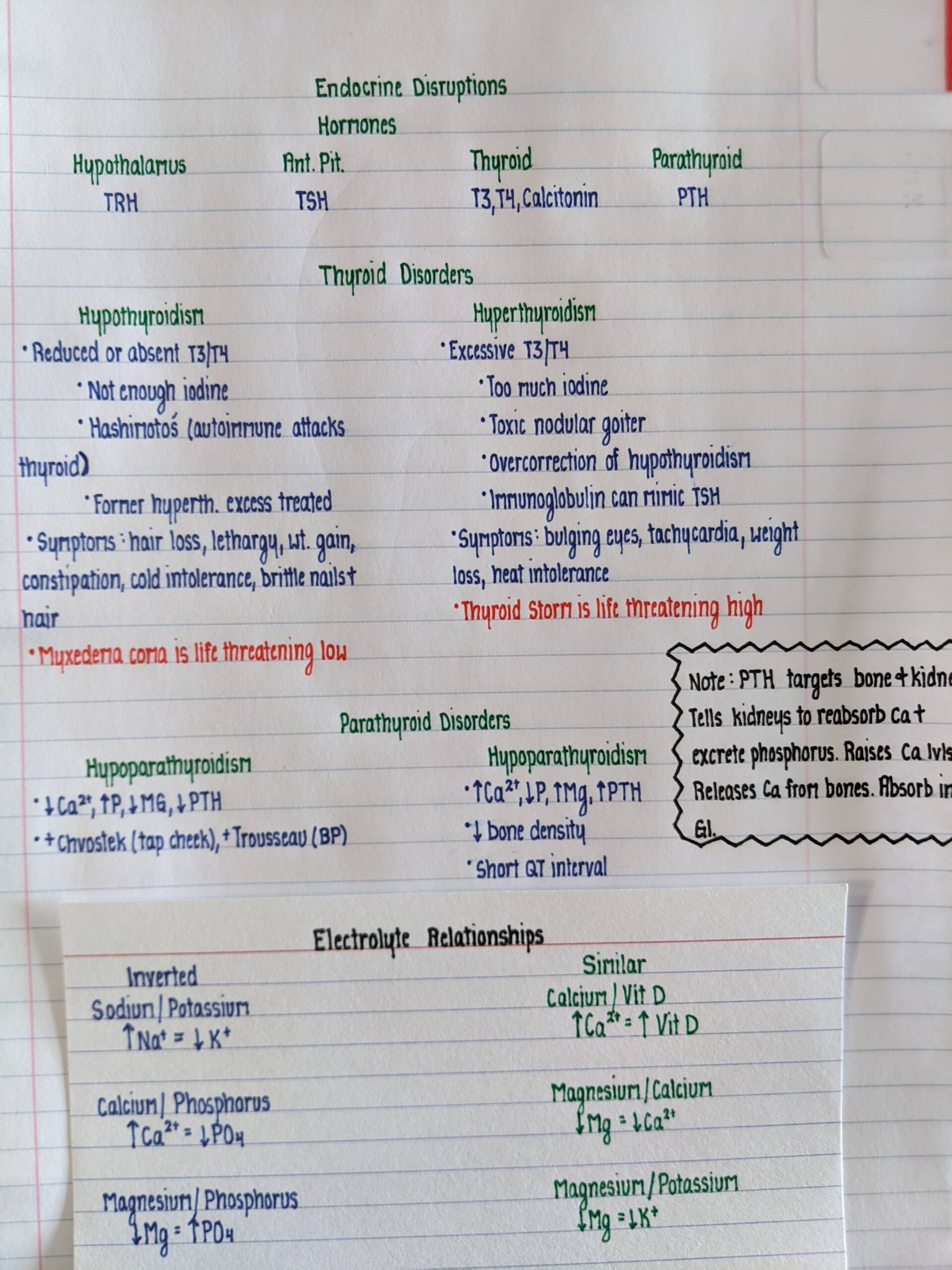
Let us look at a real example. Here are actual handwritten nursing notes covering endocrine disruptions, thyroid disorders, and electrolyte relationships:
Sound familiar? Color-coded chaos. Abbreviations everywhere. Arrows connecting concepts. Good information, but impossible to quiz yourself from directly. Typing all of this into Quizlet would take an hour or more.
Here is what Cruxly generates from this single page in under 60 seconds:
Organized Notes
- Clear overview of endocrine disruptions and their relationship to hormones
- Structured breakdown of thyroid disorders (hypothyroidism vs hyperthyroidism)
- Parathyroid disorder explanations with calcium regulation
- Electrolyte relationship formulas explained
Key Definitions Extracted
- T3: Triiodothyronine, a thyroid hormone that regulates metabolism and energy levels
- T4: Thyroxine, converted to T3 in the body, vital for metabolic processes
- PTH: Parathyroid hormone, increases blood calcium by promoting release from bones
- TSH: Thyroid-stimulating hormone, released by anterior pituitary to stimulate thyroid
- Chvostek’s Sign: Clinical sign of hypocalcemia where tapping facial nerve causes twitching
- Trousseau’s Sign: Clinical sign of hypocalcemia with carpal spasm during BP cuff inflation
Comparisons Identified
- Hypothyroidism vs Hyperthyroidism: Reduced or absent T3/T4 vs. Excessive T3/T4
Critical Warnings Flagged
- Myxedema coma is life-threatening (severe hypothyroidism)
- Thyroid Storm is life-threatening (severe hyperthyroidism)
Quiz Questions Generated
- What are the symptoms of hypothyroidism?
- What causes Hashimoto’s thyroiditis?
- How does PTH affect calcium and phosphorus levels?
- What is the relationship between sodium and potassium levels?
- What is Chvostek’s sign and what does it indicate?
- What is the life-threatening complication of untreated hyperthyroidism?
Memory Aids Created
- Thyroid vs Parathyroid: Thyroid controls metabolism, Parathyroid controls calcium
- Electrolyte Relationships: Think of it as the balancing act of minerals in the body
From one photographed page of handwritten notes, you now have organized study material, testable definitions, comparison charts, warning flags for critical content, and ready-to-use quiz questions. No typing. No formatting. No deciding what is important enough to include.
This is what AI study tools make possible. The bottleneck between having notes and being able to test yourself disappears.
Let us consider what this means for HESI A2 Anatomy and Physiology preparation specifically.
Imagine you are studying the cardiovascular system. You have your professor’s lecture slides, some handwritten notes from class, and the relevant textbook chapter. Traditionally, you would need to synthesize all of this information manually, identify what is most important, create study materials, and then actually study.
With an AI study tool, you photograph your lecture slides. The AI extracts the key concepts: heart chambers, blood flow pathways, major vessels, cardiac cycle phases. It generates flashcards like “What is the function of the left ventricle?” and “Trace the path of blood from the right atrium through the pulmonary circuit.” It creates quiz questions that test whether you can apply this knowledge, not just recognize terms.
Within minutes, you have a complete study set for that topic. You can immediately start testing yourself, which is the activity that actually produces learning.
The time savings compound across your entire study plan. If you can create study materials 90% faster, you can spend that reclaimed time on active recall. You can cover more material. You can space out your study sessions properly because you are not racing against a flashcard creation deadline.
Building Your HESI A2 Anatomy and Physiology Study Plan
Now let us get practical. Here is how to structure your HESI A2 preparation using AI study tools to maximize your score.
Weeks 4-3 Before the Exam: Content Loading
Your goal in the first phase is to convert all your existing materials into testable formats. Work through each body system methodically.
Start with whatever materials you already have. This might include lecture notes from your prerequisite A&P courses, a HESI A2 prep book, your anatomy textbook, or even study guides you find online. For each body system, photograph or scan the relevant pages and let the AI generate study materials.
Do not try to study everything immediately. Your goal is to build a comprehensive quiz bank that you will use in the following weeks. Think of this as loading ammunition. You are creating the tools you will need for active recall.
By the end of this phase, you should have flashcards and quizzes covering all major body systems. The AI will have extracted key terms, structures, functions, and relationships from your source materials.
Weeks 2-1 Before the Exam: Active Recall Focus
Now the real studying begins. With your quiz bank built, you can spend every study session testing yourself rather than preparing to study.
Work through your flashcards using spaced repetition. Focus extra attention on cards you miss, as these represent gaps in your knowledge. The AI-generated quizzes let you simulate exam conditions and identify weak areas.
For anatomy and physiology specifically, pay attention to questions that require you to connect information across systems. The HESI A2 often asks application questions like “Which hormone would increase in response to low blood calcium levels?” Answering correctly requires you to understand the endocrine system (parathyroid hormone), the skeletal system (calcium storage in bones), and the relationship between them.
If you discover a weak area, go back to your source materials, photograph the relevant sections, and generate additional study materials. The speed of AI generation means you can address gaps in real time rather than hoping you will get lucky on exam day.
Final Week: Test Simulation
In the final week, shift your focus to timed practice tests. Many students neglect timing in their preparation and then feel rushed during the actual exam.
Use any practice tests available in your prep materials. Pay attention not just to which questions you miss, but to which question types cause you trouble. If you consistently struggle with “identify the structure” questions, spend extra time with visual diagrams. If you miss questions about physiological processes, focus on sequence and function rather than isolated definitions.
The AI-generated quizzes from your study sessions can also function as practice tests. Set a timer and work through a set number of questions to simulate exam pressure.
System-by-System Study Strategies for HESI A2 A&P
Different body systems require slightly different study approaches. Here is what to focus on for each major system you will encounter on the HESI A2.
Skeletal System
The skeletal system is heavily visual. You need to know the names and locations of major bones, bone classifications (long, short, flat, irregular), and bone tissue composition. AI study tools excel here because you can photograph skeletal diagrams and generate identification quizzes automatically.
Focus on bones that are commonly confused: ulna vs. radius, fibula vs. tibia, lumbar vs. thoracic vertebrae. Flashcards asking “Which bone is on the medial side of the forearm?” force you to recall both the bone name and its anatomical position.
Muscular System
The muscular system requires understanding both structure and function. You need to know muscle types (skeletal, smooth, cardiac), major muscle groups, and the basic mechanism of muscle contraction.
Pay special attention to muscle actions. Knowing that the biceps brachii flexes the elbow is more likely to be tested than knowing how many heads the muscle has. AI-generated flashcards from your lecture slides will typically capture these functional relationships.
Nervous System
The nervous system is conceptually the most complex. You need to understand neuron structure, nerve impulse transmission, brain regions, spinal cord organization, and the autonomic nervous system divisions.
Visual diagrams are essential here. Photograph diagrams of neurons, brain cross-sections, and reflex arcs. The AI can generate questions about structure (“What is the function of the myelin sheath?”) and process (“Describe the sequence of events in a reflex arc”).
Cardiovascular System
Blood flow pathways are a HESI A2 favorite. You absolutely must be able to trace blood from the right atrium through the pulmonary circuit and back through the systemic circuit. Practice this sequence until it is automatic.
Also focus on the cardiac cycle, blood pressure regulation, and the major blood vessels. Generate flashcards that quiz you on vessel names and the regions they supply.
Respiratory System
The respiratory system is relatively straightforward in terms of structures, but make sure you understand gas exchange at the alveolar level. Partial pressure gradients and oxygen-hemoglobin binding are frequently tested concepts.
Digestive System
The digestive system involves a long sequence of organs and processes. Trace the path of food from mouth to anus, noting what happens at each stage. Enzyme names (amylase, pepsin, lipase) and their functions are common test targets.
Endocrine System
The endocrine system requires you to match hormones with their glands, targets, and effects. This is pure memorization, and flashcards are the ideal study tool. Generate cards like “Parathyroid hormone: source, target, effect” and drill until you can answer without hesitation.
Urinary System
Understand nephron structure and the process of urine formation. Filtration, reabsorption, and secretion are key concepts. Also know how the kidneys regulate blood pressure and pH.
Reproductive System
The reproductive system typically appears as a smaller portion of the HESI A2, but do not neglect it. Know the major structures in both male and female systems, and understand the hormonal regulation of reproduction.
Common Mistakes to Avoid
As you prepare for the HESI A2 Anatomy and Physiology section, watch out for these common pitfalls.
Studying without testing. If you spend an hour reading notes but never quiz yourself, you have not really studied. Active recall is not optional. It is the mechanism by which learning actually occurs.
Creating flashcards manually when AI can do it faster. Your time is limited. Every hour you spend typing flashcards is an hour you could have spent using flashcards. Let AI handle the creation so you can focus on the learning.
Ignoring visual material. Anatomy is inherently visual. If you are only studying text definitions, you are missing half the content. Make sure your study materials include diagrams, and practice identifying structures from images.
Waiting until the last week to take practice tests. Practice tests are learning tools, not just assessment tools. Taking them early reveals gaps you can still address. Taking them only at the end just confirms what you do not know without time to fix it.
Studying systems in isolation. The body works as an integrated whole, and the HESI A2 tests this integration. As you study each system, consciously think about how it connects to others. How does the nervous system regulate the cardiovascular system? How do the respiratory and urinary systems both contribute to pH balance?
What Score Do You Need?
Different nursing programs have different HESI A2 score requirements, so check with your target schools for specific cutoffs. However, some general guidelines apply.
Most competitive nursing programs look for a composite score of 80% or higher. For individual sections like Anatomy and Physiology, scoring above 80% demonstrates solid preparation. Elite programs may expect scores in the 85-90% range.
Remember that the HESI A2 is one component of your application. A strong A&P score will not guarantee admission, but a weak score can definitely hurt your chances, especially if A&P is heavily weighted by your program.
Start Now, Not Later
The biggest predictor of HESI A2 success is not intelligence, prior coursework, or natural ability. It is time. Students who start preparing early and use effective study methods consistently outperform those who cram.
If you are reading this article, you are already thinking about your preparation. That is the first step. The next step is to actually begin.
Take out your anatomy and physiology materials right now. Open Cruxly or whatever AI study tool you choose. Photograph the first chapter or the first body system. Generate your first set of flashcards and quizzes. Test yourself on five questions.
That is it. You have begun.
Do this consistently over the coming weeks, and you will walk into your HESI A2 with confidence built on real preparation, not hope built on highlighting.
Your nursing school admission is on the other side of this exam. Make the study time count.
Frequently Asked Questions
How many questions are in the HESI A2 Anatomy and Physiology section?
The A&P section typically contains 25-30 questions, though the exact number can vary by testing site and version. You will have limited time per section, so familiarity with the content is essential for working at the required pace.
What topics are most commonly tested on the HESI A2 A&P section?
Body systems appear with roughly equal frequency, but cardiovascular, nervous, and muscular systems tend to have more questions due to their complexity. Terminology questions (anatomical directions, body planes, tissue types) also appear regularly.
Can I use AI to study for other HESI A2 sections?
Yes. AI study tools work for any content that can be photographed or scanned. The Reading Comprehension and Vocabulary sections can benefit from AI-generated flashcards for terms and concepts. Even the Math section can be supported by generating practice problems from your notes.
How long should I study for the HESI A2?
Most successful candidates study for 4-8 weeks, depending on their prior knowledge and available study time. If you are taking prerequisite courses concurrently, you may need less dedicated HESI prep time since you are learning the content in class. If you are reviewing material from courses you took years ago, budget more time.
Is the HESI A2 harder than the actual nursing school coursework?
The HESI A2 tests foundational knowledge that you will build upon in nursing school. The content itself is not more difficult than what you will encounter later, but the breadth of topics covered in a single exam can feel overwhelming. Nursing school courses go deeper into fewer topics at a time.
What if I fail the HESI A2?
Retake policies vary by school and testing center. Many students are allowed to retake the exam after a waiting period, though some schools limit the number of attempts. Check with your target programs for their specific policies. A focused study plan using active recall and spaced repetition will help you improve your score on subsequent attempts.